




As generative AI makes execution accessible to everyone, competitive advantage is shifting towards strategic judgement, not content production.
The creative industry is becoming obsessed with execution again. Except this time, execution is almost free.
Every week brings another tool capable of generating better images, better videos, better copy and better presentations. The barrier to producing something that looks professional has quietly collapsed. And yet, as the quality of generated content rises, much of it begins to look strangely alike.
The assumption behind the excitement is easy to understand: if everyone has access to the same powerful tools, the winners will be the ones who produce the most. I believe the opposite is happening.
AI Is Compressing the Value of Execution
Twenty years ago, execution was the moat. A polished campaign required a retoucher, a photographer, a studio, a production budget and weeks of coordination. The ability to make the thing was scarce, and scarcity created value. Agencies were paid, in large part, for the difficulty of production.
That difficulty is disappearing. What once took a team and a week can now be explored before lunch. This is genuinely good news, and I don’t want to romanticise the old constraints. But it changes the economics of creative work in a way many teams haven’t fully absorbed.
When execution becomes abundant, its value falls. Anything that can be produced by anyone, instantly, cannot be the thing you compete on. This is a pattern economists have watched play out across every industry AI touches: as one bottleneck is removed, value migrates to whatever bottleneck remains. In creative work, the remaining bottleneck is not production. It is deciding what is worth producing at all.
AI is compressing the value of execution while raising the value of judgement. The best prompt doesn’t win. The best question does, because a prompt is only ever downstream of the thinking that shaped it.
AI Is Creating an Illusion of Expertise
Here is the more uncomfortable consequence. For the first time in history, technology allows mediocre thinking to look exceptionally polished.
A weak strategy can now arrive beautifully art-directed. A shallow insight can be wrapped in confident copy and a striking image. The surface has never been more convincing, which means the surface has never been a less reliable signal of quality.
This is the quiet risk of the current moment: AI is masking the absence of strategic skill. It fills the gaps that experience used to fill, and it fills them fluently enough that the gaps become hard to see, sometimes even for the person producing the work. Polish used to be evidence of care and craft. Now polish is the default, and evaluating an idea takes more discernment than it did before, not less.
Brands that mistake fluency for thinking will feel productive while becoming interchangeable. They will publish more, faster, and wonder why none of it moves anyone.
Why Senior Thinking Matters More Than Ever
The instinctive reading of all this is that experience is being replaced. Cheaper, faster, tool-fluent talent can now produce what used to require years. On the surface, the maths seems to favour whoever adopts the tools first.
I’d argue the maths is being read wrong.
AI can generate. It can accelerate. It can help overcome a creative block, structure a strategy, or surface an angle you hadn’t considered. What it cannot do is decide which ideas are worth amplifying. It has no independent point of view on whether an answer is technically correct but strategically wrong. It cannot hold the whole picture, the market, the history, the cultural undertone, the client’s real problem behind the stated brief, and choose.
That capacity, seeing the big picture and exercising judgement inside it, is exactly what deep experience produces. And it becomes more valuable as execution becomes free, not less, because it is now the scarce input.
One clarification matters here, because it’s easy to turn this into an argument about age or hierarchy. It isn’t. Shallow thinking exists at every level of seniority, and brilliant thinking exists at every level too. I’ve seen juniors with sharper judgement than people three titles above them. The distinction that matters isn’t seniority. It’s judgement. AI simply raises the reward for having it and raises the cost of pretending to.
Brands Do Not Need More Content. They Need More Meaning.
If anything, AI has made one thing clearer to me than it ever was before: everything a brand puts into the world now has to mean something, and mean it on purpose.
When content was expensive, volume was itself a kind of signal, proof a brand was serious and well-resourced. Now that anyone can generate an endless stream of on-brand material, volume signals nothing. The feed is saturated. Attention has not expanded to match. In that environment, the only thing that earns a second of a real person’s time is meaning: a point of view, a reason to care, something true that the reader didn’t already know.
Most companies are still solving the wrong problem. They are optimising for quantity, more posts, more variants, more channels, when the scarce resource is quality of thought. More content, produced faster, does not build a stronger brand. It usually builds a blander one, because it converges on the statistical average of everything the model has already seen.
The brands that will stand out are the ones willing to say less, and mean more.
In Practice: The Polish Institute Berlin
A project I led for the Polish Institute in Berlin made this real for me, and it did so from both directions.
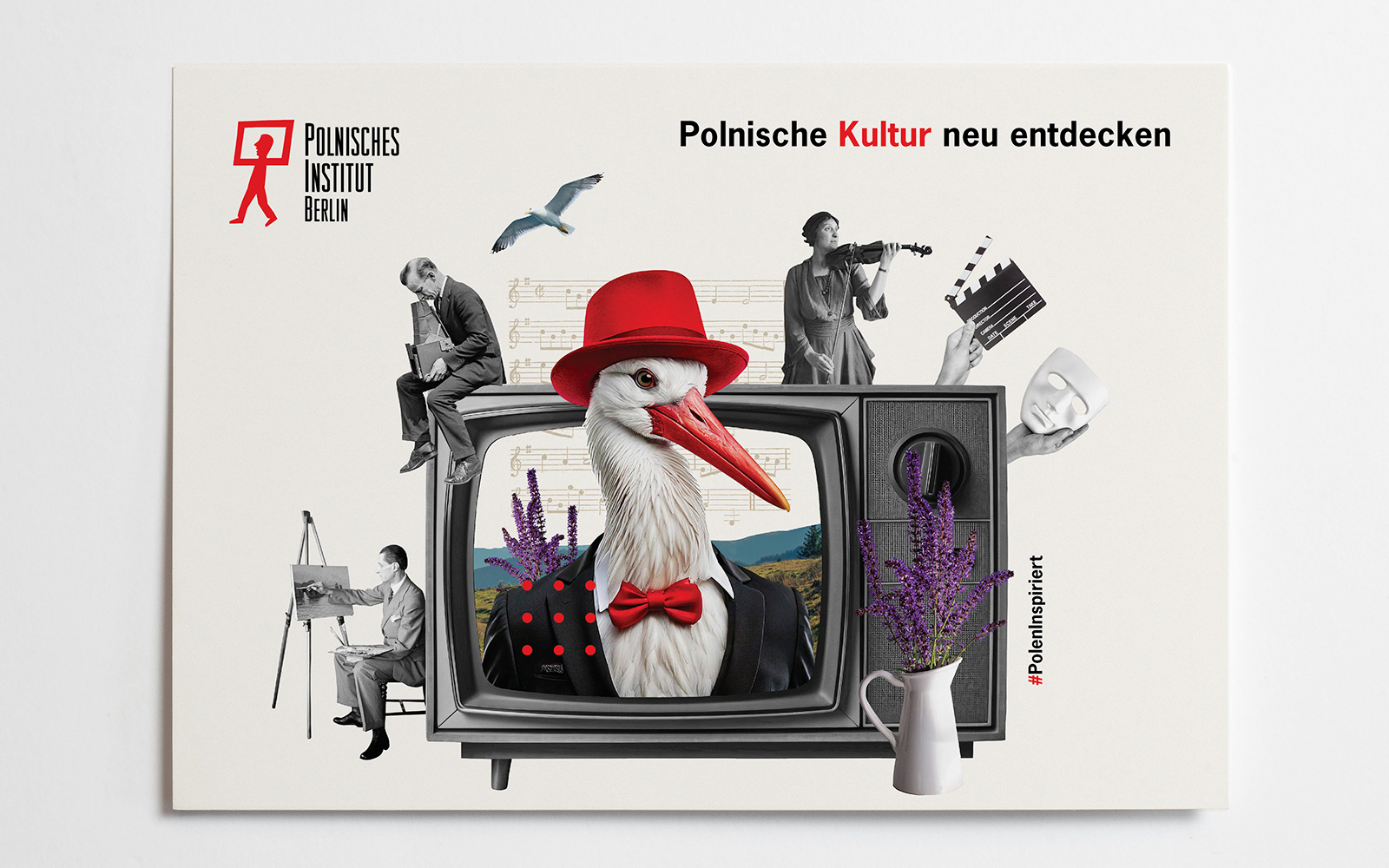
The brief was a perception problem. Many Berliners still carried an old, slightly dusty image of Poland, traditional, a little stuck in the past. The Institute wanted to surprise them: to show a country that is modern, confident and culturally alive without denying where it came from.
The idea we built the campaign around was a stork, Poland’s national symbol, reimagined as an elegant, self-assured figure in a suit, stepping out of an old television set surrounded by monochrome scenes of Polish music, art and theatre. Old and new in a single frame. A nation proud of its history and unmistakably done being defined by it. This was my first serious experiment with generative AI, and I fell for the medium precisely because it let me realise that image at a fidelity I couldn’t have reached otherwise. AI didn’t have the idea. It executed an idea that came from understanding the audience, the history and the emotional shift we needed to create.
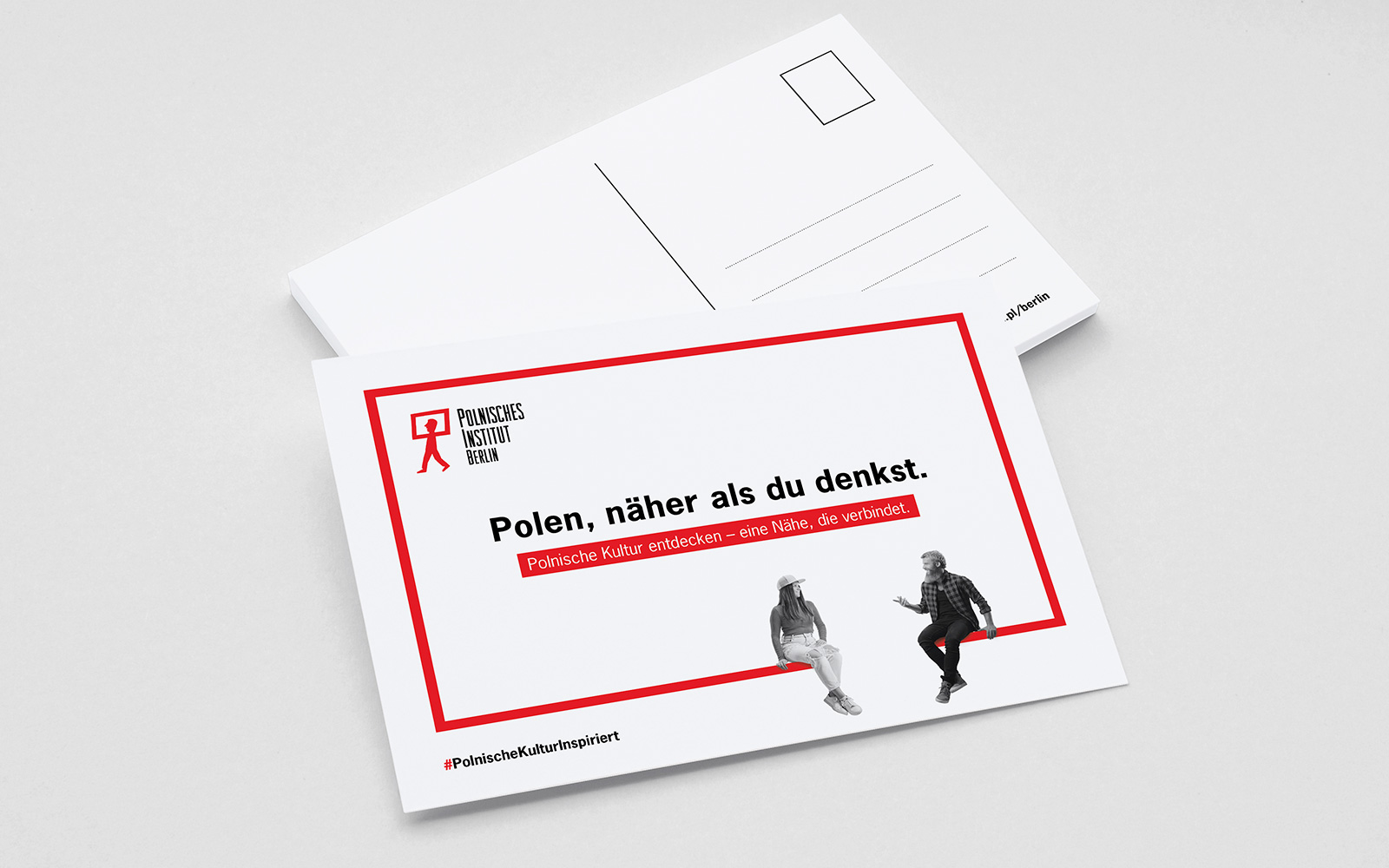
And here is the part I find most telling. The strongest concept in that whole body of work used no AI at all: a simple image of Germans and Poles seated at opposite ends of a single red line, in conversation, closer and more connected than either side tends to assume. No model produced that. It came from thinking about the relationship. The tool was irrelevant to why it worked.
The project didn’t prove that AI makes better creative. It proved that judgement decides whether the tool matters at all.
Practical Perspective
For leaders and creative teams, the shift is less about which tools to buy and more about what to protect and reward.
Stop treating tool fluency as the skill. It’s now table stakes, like knowing how to use a keyboard. Hire, promote and brief for judgement instead: the ability to frame the right problem, to reject a technically good idea for a strategically better one, to explain why an execution earns its place. In practice that means spending more of your process on the question, not the output, and being willing to leave the AI’s first, fluent, plausible answer on the table when it isn’t actually right.
It also means resisting the volume trap. The pressure to fill every channel because you now can is real, and it quietly lowers the standard. Fewer, sharper, more meaningful pieces will almost always outperform a high-frequency stream of competent sameness. Give your best thinkers time to think, and treat that time as the deliverable it actually is.
The MidPoint Takeaway
The future of branding won’t belong to the teams with the best tools. It will belong to the ones with the best judgement.
Generative AI has made execution nearly free, and in doing so it has quietly moved the entire game. When anyone can produce the work, the advantage moves to whoever can decide which work is worth producing, and why it matters. Prompts are cheap. Thinking is not.
The question is no longer whether you can make it. It’s whether you should, and whether it means anything once you have.
Ewa Gillen
Brand & Creative Lead
Healthcare, Technology and Science | B2B & Purpose-Driven Brands
MidPoint explores the intersection of brand strategy, creativity and AI transformation.
References
- Iansiti, Marco, and Karim R. Lakhani. Competing in the Age of AI: Strategy and Leadership When Algorithms and Networks Run the World. Boston, MA: Harvard Business Review Press, 2020.
- Harvard Business School Online. AI Essentials for Business. Professors Karim R. Lakhani and Marco Iansiti, 2026.
AI Transparency
Generative AI supported the research and editorial process for this article, and generative AI was used to produce the campaign imagery described in the Polish Institute Berlin project. All strategic direction, creative judgement and final editorial responsibility remain with the author.


Comments are closed.