



Generative models are trained on what a culture has already written down. The commercial opportunity is in what it hasn’t.
In December 2025, seventeen clinicians, pharmacists and researchers set out to test how well the leading language models handle women’s health. They wrote realistic questions of the kind patients and doctors actually ask, put them to thirteen state-of-the-art models, and had the answers reviewed by specialists. Across all models, the failure rate was roughly 60%. The best performer, GPT-5, was wrong slightly more often than it was right. 1
The temptation is to read that as a story about model quality, and to assume the next release will fix it. I read it differently. What that benchmark measures is not really the intelligence of the models. It is the shape of what we, collectively, have bothered to write down.
Because the gaps are not random. They cluster with unnerving precision around subjects our culture has been reluctant to discuss out loud. And once you accept that, a question that looks like a technical problem turns into a strategic one: if AI is weakest where we have said least, then the map of AI’s blind spots is also a map of unmet demand.
Models inherit our silences before they inherit our knowledge
A language model is built from what has already been written down, confident where the writing is plentiful, vague where it is thin. And how much got written about any given subject was never decided by the world. It was decided by us, through decades of choices about what deserved funding, what got published, and what people were willing to say out loud.
Follow that chain backwards through a single subject and it becomes uncomfortably clear. Only 8.8% of NIH grant spending between 2013 and 2023 went to women’s health research, and that share has fallen while the agency’s budget has grown.2 Across 740 cardiovascular trials, women made up 38.2% of participants in the disease category that kills more women than any other.3 And where both sexes are enrolled, the results are usually pooled: in one Australian review, fewer than 9% of mixed-sex trials analysed their data by sex at all. 4
Underfunded, then under-enrolled, then under-analysed, then under-published. Four filters, each narrower than the last, every one of them applied long before a word of it reached a training set.
The team behind that benchmark close the loop themselves: a subject underrepresented in research will be underrepresented in the data these models learn from. And this is the part most leaders miss. We picture AI as a mirror held up to human knowledge. It behaves more like a lens, brightening what was already well lit, deepening everything else. Whatever a culture has avoided discussing, these systems will underserve, fluently and confidently and at scale.
Silence is not the absence of a market. It is the absence of supply.
Researchers at Data & Society named this years before it mattered commercially. A data void is a question people are genuinely asking that almost nobody has answered well. Their worry was manipulation: voids get filled, and whoever fills one first owns the answer. Turn it around and you have a market. Demand that gathered long ago, waiting for a supply that never arrived. 5
Consider one example. A systematic review of studies across the Western world found that roughly one in three women experience urinary incontinence in the year after giving birth. 6 Yet women with the condition live with symptoms for more than six years before raising it with a doctor, and roughly four more before receiving effective treatment. The reasons given are shame, lack of time, and a version of the same sentence: I was told this was normal. 7
Those ten years are the point. A data void is not empty of people, only of answers. The demand is there the whole time, but it never reaches anyone who might write it down, so nothing gets published and nothing exists for a search engine, or a model, to find. No keyword tool will show you this, because search volume measures the questions people have learned they are allowed to ask out loud and badly undercounts the ones they are still ashamed to type. The tools point you at crowded ground and leave you blind to the ground worth owning.
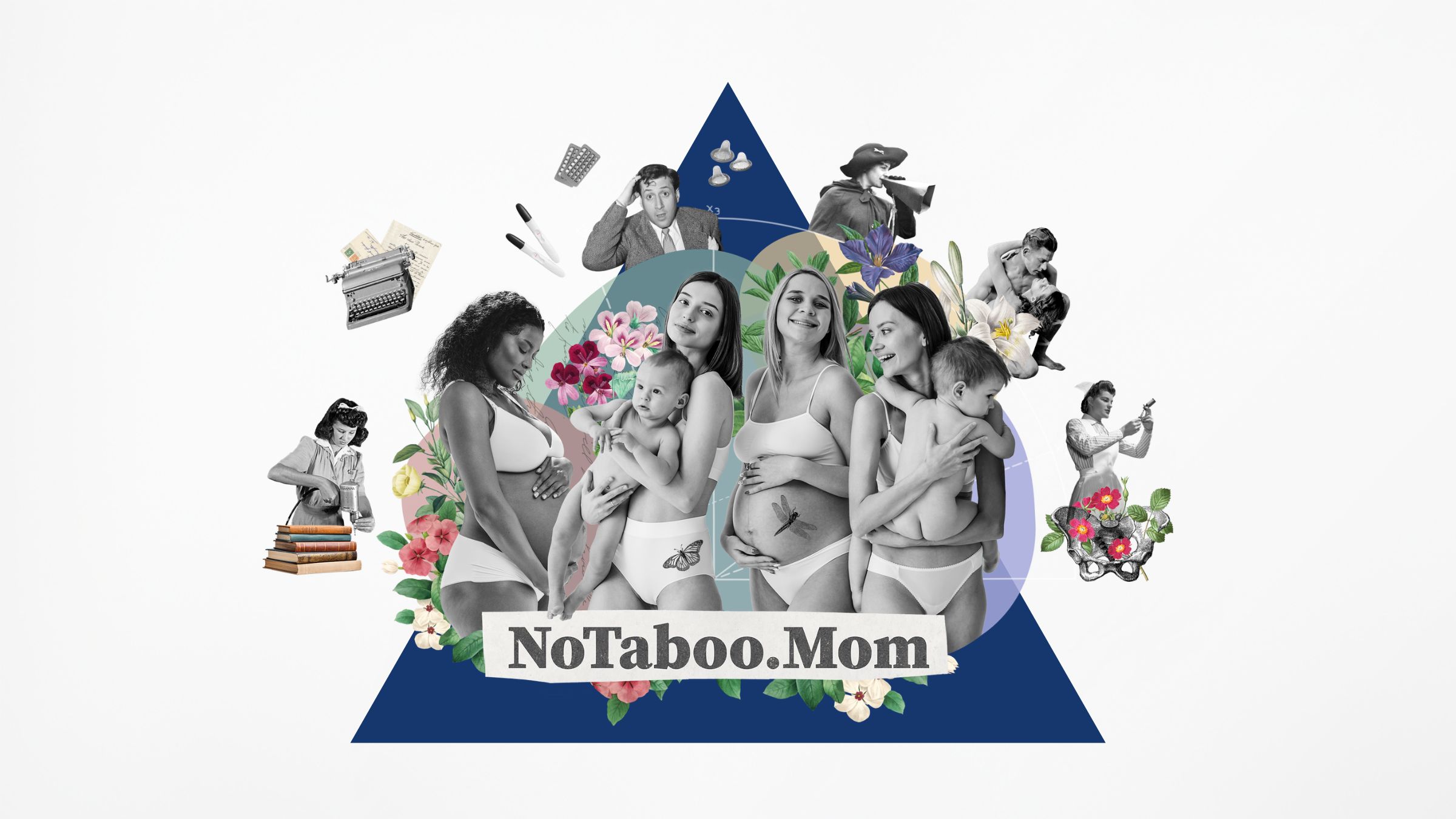
No Taboo Mom: a brand built where nothing had been written
I know this because I built one there.
No Taboo Mom began in 2024 because two women went looking for honest conversations about pregnancy, birth and what happens to a body and a life afterwards, and could not find them. My co-founder, Julia Kolbe, trained and worked as a psychiatric nurse and holds a Master’s in Health, Nursing and Medical Education. She had seen where the system fails women from the inside, then experienced two very different births, one in hospital and one at home, from the receiving end. I came to it from brand strategy and from my own transition into motherhood in 2020.
That pairing was not a nice detail. It was the credibility structure. Clinical knowledge without lived experience produces guidance nobody can use. Lived experience without clinical grounding produces anecdote. Together they made the material trustworthy enough to be worth gathering, which mattered, because gathering it was the actual work.
This is the part that differs from every other branding project I have run. Normally a client arrives with material and the job is to organise, sharpen and amplify it. Here there was almost nothing to organise. Before any identity work could begin, we had to go and get the content: first-person accounts from women who had never told anyone, sitting alongside expert knowledge. Brand building started one step earlier than usual, at acquisition rather than expression.
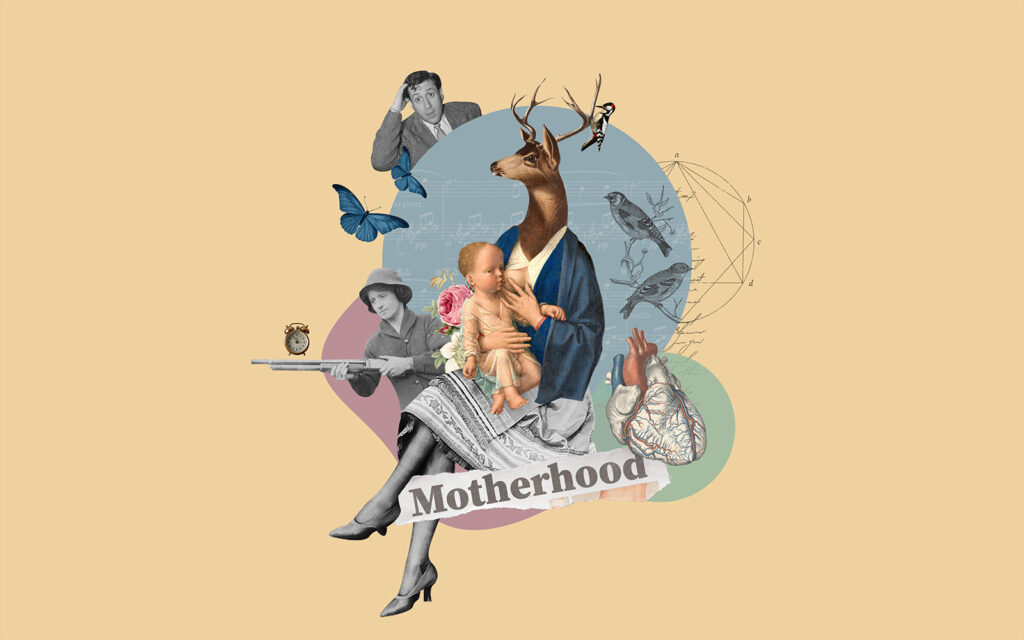
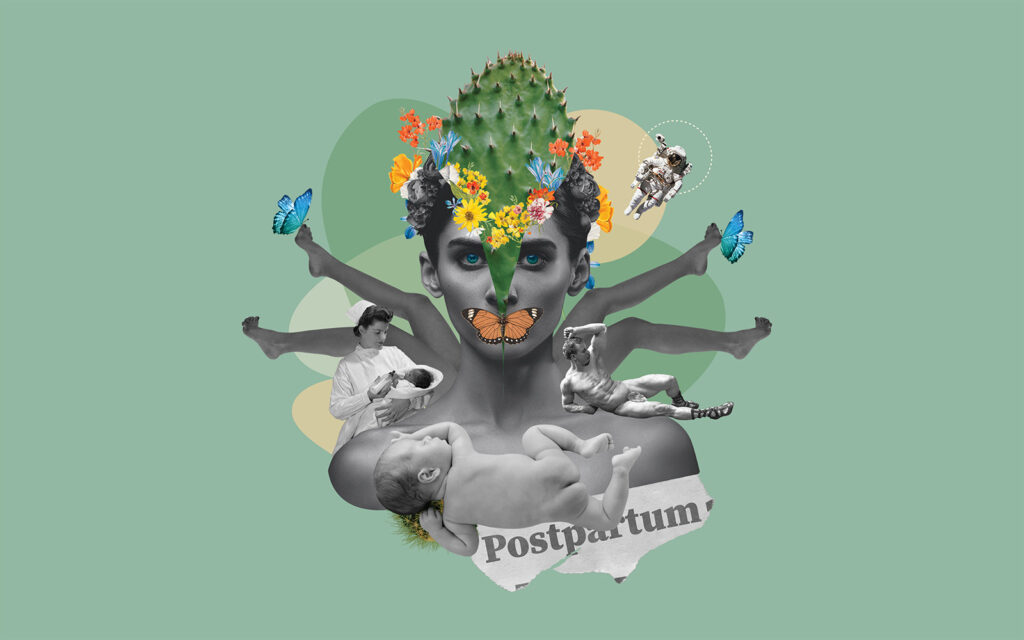
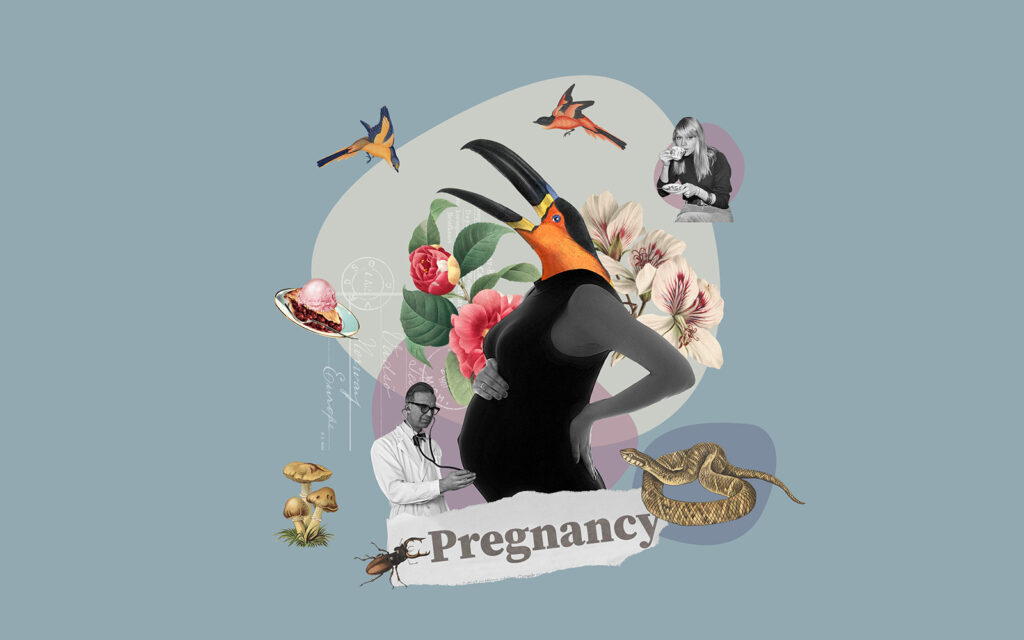
Everything visual then followed from that position rather than preceding it. The identity uses collage, vintage photography fused with natural objects, because the argument was that these silences persist across generations and a contemporary illustration style would have contradicted it. Six content categories each carry their own colour, so a woman can navigate to her own subject without having to name it out loud first. The design was not decoration applied to difficult content. It was a permission device, engineered to lower the cost of entering a conversation people find hard to start.
One thing we did not plan for became central. Women write to us with personal questions, and where we can we connect them to organisations and specialists who can genuinely help, among them MASIC, the UK charity supporting women with severe birth injuries, and Dr med. Martina Lenzen-Schulte, who documents birth risks for German-speaking readers. It costs time we cannot bill. It is also the clearest evidence that the position is real: you only become a referral point if people arrive somewhere expecting an answer and find one.
The platform was nominated for Project of the Year 2023/2024 by STGU, the Association of Applied Graphic Designers in Poland, in the Impact category, which judges what design achieves socially rather than how it looks. In September 2025 the site was selected as Best Website Design by DesignRush. I mention both for one reason. They arrived last, and they confirmed from outside that the gap had been real.
Because here is what the project actually taught me. The art direction, which is the part people compliment, could be approximated by a competent studio in an afternoon. The archive could not. Years of women trusting us with things they had told nobody else is not a style, and it cannot be generated, licensed or prompted into existence.
You can read the platform at notaboo.mom, follow it on Instagram, or listen to the podcast.



What this changes for creative teams
For most of my career, the scarce thing in creative work was execution: the studio, the retoucher, the production budget. That scarcity is gone. The scarce thing now is material nobody else holds, and that has quietly moved the centre of gravity of a creative team from the studio to the interview.
Three practical consequences follow.
Use the models to find your own silences. Take the twenty questions your customers genuinely ask, not your keyword list but the real ones your sales and service teams hear, and put them to the best model you have. Read the answers as a diagnostic rather than an output. Where it hedges, generalises, or is confidently wrong, you have found a subject with real demand and thin documentation. Every competitor’s model is producing the same hollow answer. That is a map, drawn in an afternoon.
Then ask why it is quiet. A gap on its own proves nothing. Some subjects are undocumented because of stigma or neglect, and there is genuine work to do. Others are undocumented because nobody needs them answered. The discipline is in telling those apart before committing a budget.
And do not fill it with generated content. This is the trap. Having found a silence, the efficient move looks like producing two hundred articles quickly and claiming the ground. That destroys the asset in the act of monetising it, because the value was that the material was scarce, verified and human. Holding the position requires named people accountable for what is published, visible provenance for where the knowledge came from, honesty about the limits of what you know, and a willingness to send people elsewhere when the answer is not yours to give.
In budget terms, all of this means money moves from production to acquisition. Interviews, field research, practitioner time and expert review stop being overheads on the way to a deliverable and become its actual cost base. Production has never been cheaper. The ratio between those two lines is now one of the clearest signals of whether an organisation has understood what changed.
The MidPoint Takeaway
These systems are fluent about everything we have already said, and empty on everything we haven’t.
For two decades, brand strategy largely meant finding a distinctive angle on a well-covered subject. That is now the cheapest work in the world to produce, which is precisely why it no longer distinguishes anyone.
What remains scarce is material that has never been written down. There is only one way to obtain it, and it has not changed in a hundred years: go and ask someone, listen properly, and write down what they said.
The most valuable thing a brand can own is now a conversation nobody else has bothered to have.
The MidPoint Takeaway
Ewa Gillen
Brand & Creative Lead
Healthcare, Technology and Science | B2B & Purpose-Driven Brands
MidPoint explores the intersection of brand strategy, creativity and AI transformation.
References
- A Women’s Health Benchmark for Large Language Models.
- A New Vision for Women’s Health Research: Transformative Change at the National Institutes of Health.
- Women’s Participation in Cardiovascular Clinical Trials From 2010 to 2017.
- Mind the Gap: Reporting and Analysis of Sex and Gender in Health Research in Australia, a Cross-Sectional Study.
- Data Voids: Where Missing Data Can Easily Be Exploited
- Prevalence, incidence and bothersomeness of urinary incontinence between 6 weeks and 1 year post-partum: a systematic review and meta-analysis
- Novel EMPOWER Study of Female Urinary Incontinence Reaches Halfway Point
- Harvard Business School Online. AI Essentials for Business. Professors Karim R. Lakhani and Marco Iansiti, 2026.
AI Transparency
Generative AI supported the research and editorial process for this article, and generative AI was used to produce the campaign imagery described in the Polish Institute Berlin project. All strategic direction, creative judgement and final editorial responsibility remain with the author.


Comments are closed.