



Most organisations are using AI to work faster.
Very few are using it to become smarter.
Artificial intelligence has become impossible to ignore. New tools appear almost weekly, agencies proudly announce AI-powered services, and every creative team seems to have its favourite combination of ChatGPT, Claude, Firefly, Midjourney or Runway.
Yet despite all this experimentation, I don’t believe the biggest transformation is happening inside the tools themselves. It’s happening in the way organisations work.
After completing Harvard Business School Online’s AI Essentials for Business, one idea stayed with me more than any discussion about prompting, automation or image generation: becoming AI-first isn’t about adopting more technology. It’s about redesigning how decisions are made, how knowledge is shared and how organisations learn.
That’s a much bigger shift than downloading another application.
AI adoption is not AI transformation
Much of today’s conversation still revolves around Generative AI, and for good reason. Large Language Models (LLMs) such as ChatGPT, Claude or Gemini can generate text, summarise information and support reasoning, while image generation models such as Firefly or Midjourney rely largely on diffusion models to create entirely new visuals from learned patterns and help creatives explore visual directions in minutes rather than hours.
These tools are remarkable. But they represent only one branch of Artificial Intelligence. Confusing the use of Generative AI with becoming an AI-first organisation is where many creative teams go wrong. Buying subscriptions isn’t a strategy. Neither is encouraging everyone to “experiment.”
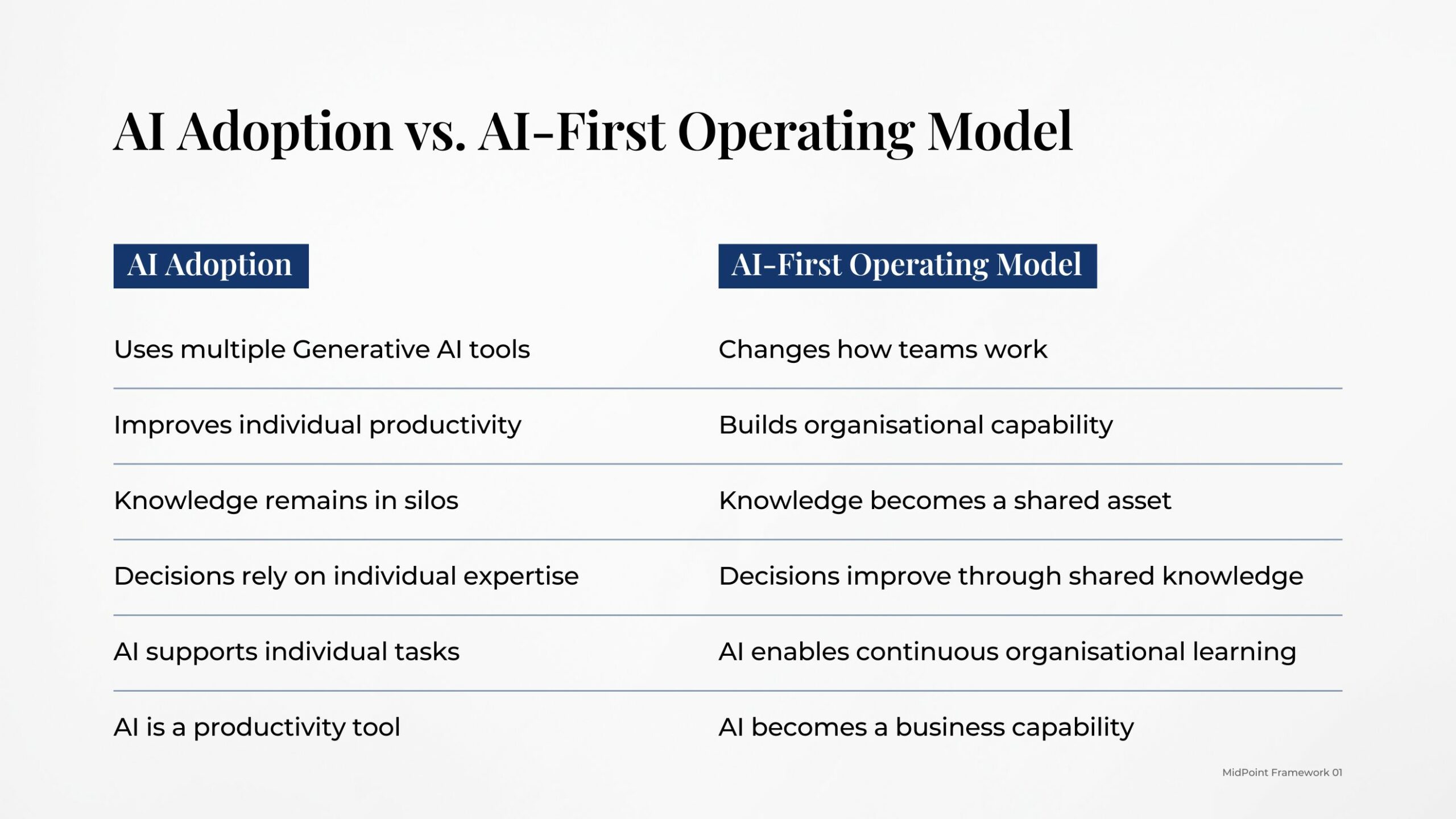
An organisation doesn’t become AI-first because every designer has a favourite image generator or every copywriter uses an LLM. That’s simply individual productivity. Transformation begins only when AI becomes part of the organisation’s operating model, when teams rethink how knowledge flows, how decisions are made, and how expertise is shared instead of remaining locked inside individuals.
Creative work is accelerating, but knowledge isn’t
One observation keeps coming back in conversations with creatives across the industry. Everyone is moving faster. Research takes minutes instead of hours. Initial concepts arrive almost instantly. Moodboards, copy explorations and campaign variations that once required days can now be produced before lunch.
But while production has accelerated dramatically, many organisations still learn at exactly the same speed they did before AI. One strategist discovers an effective prompting technique but never shares it. A designer develops a workflow that cuts production time in half, yet it remains hidden on a personal desktop. Another team experiments with AI-assisted research, while colleagues across the office unknowingly solve the same problem from scratch.
The result is an organisation where AI improves individual performance without improving organisational intelligence. Ironically, this is also contributing to another challenge: creative convergence. When thousands of teams rely on similar models trained on similar datasets and approach them in similar ways, ideas naturally begin to cluster around the average. Faster production is valuable, but without stronger strategic thinking, brands risk becoming more efficient at looking like everyone else.
Technology isn’t creating that problem on its own. Weak creative systems are.
Design the system before optimising the output
One of the ideas explored throughout the Harvard course is that successful AI transformation is less about implementing individual tools and more about redesigning the organisation around learning.
For creative teams, that means shifting attention away from prompts and towards infrastructure. Before asking “Which AI tool should we buy next?”, a better question might be: “How does knowledge move through our organisation?”
If the answer is scattered Slack conversations, forgotten email threads, disconnected folders and individual experimentation, AI will simply make existing inefficiencies happen faster. Building an AI-first creative organisation starts with creating what I think of as a creative memory, a shared knowledge base that captures not only finished work but also the thinking behind it.
That doesn’t require expensive technology. Platforms such as Notion, Microsoft Loop, Confluence, Guru, SharePoint or even a well-structured Google Drive can become the foundation. The important part isn’t the software, it’s the discipline of documenting what usually disappears.
A useful creative knowledge system might include:
- original briefs and business objectives
- audience insights and research
- positioning decisions and strategic rationale
- concepts that were rejected and why
- approved messaging frameworks
- campaign performance and measurable outcomes
- client feedback
- lessons the next team shouldn’t have to learn again
AI can only help organisations learn from knowledge they actually preserve. If every project ends when the invoice is sent, every new project starts almost from zero.
Where to start
If you’re leading a creative team, an agency or an in-house brand function, you don’t need to become AI-first overnight. You do need to become more intentional. Start by mapping your entire creative process from briefing and research through strategy, concept development, production, approvals and performance measurement. Identify where work is repeated, where decisions depend on individual experience, and where valuable knowledge disappears after each project. Only then should you ask where AI genuinely creates value.
In many organisations, Generative AI already performs exceptionally well as a junior co-pilot. It can accelerate research, summarise complex information, generate first drafts, explore visual directions, localise content or adapt campaigns across channels.
The more important question is where humans remain irreplaceable. Strategic positioning. Creative judgment. Ethical decision-making. Cultural understanding. Building trust. Recognising when an answer is technically correct but strategically wrong. These are not tasks to automate. They’re the capabilities that become even more valuable as AI becomes more capable.
The goal isn’t to replace creative thinking. It’s to protect more time for it.
The MidPoint Takeaway
AI-first isn’t a technology strategy. It’s a knowledge strategy.
The organisations that benefit most from AI won’t be the ones with the most subscriptions or the best prompts. They’ll be the ones willing to rethink how they capture knowledge, learn from every project, and make better decisions together.
Perhaps the biggest shift isn’t learning AI. It’s learning how to learn again.
Ewa Gillen
Brand & Creative Lead
Healthcare, Technology and Science | B2B & Purpose-Driven Brands
MidPoint explores the intersection of brand strategy, creativity and AI transformation.
References
- Harvard Business School Online. AI Essentials for Business. Harvard Business School Online, 2026. Professors Karim R. Lakhani and Marco Iansiti.
AI Transparency
Generative AI and AI-assisted research tools, including ChatGPT, Claude and Perplexity, supported the research and editorial process. Final editorial responsibility remains with the author.


Comments are closed.