




International marketing has spent decades debating whether brands should standardise their marketing across countries or adapt it to individual markets.
Standardisation promises consistency, efficiency and recognisability. Adaptation promises cultural relevance. Yet decades of research have failed to establish either approach as universally superior.
That is because global brand consistency is not simply a question of repeating the same message across markets. The same expression can produce different meanings in different contexts. Language changes how ideas are understood, but so do humour, cultural references, visual conventions, expectations of authority, familiarity and trust.
This distinction is becoming more important as AI makes international communication dramatically easier to produce. Translation, localisation and content variation that once required considerable time and resources can increasingly happen almost instantly.
The operational problem is shrinking. The strategic one is not.
The question for global brand leaders is therefore becoming less about whether to standardise or adapt and more about what must remain consistent, what is allowed to change, and why.
Standardisation vs adaptation has no simple winner
The tension is hardly new. In 2003, Marios Theodosiou and Leonidas C. Leonidou reviewed 36 empirical studies on international marketing-strategy standardization and adaptation. Their conclusion was pragmatic: neither strategy was consistently superior. Whether standardization or adaptation produced better performance depended largely on the circumstances facing the firm in a particular foreign market at a particular point in time. 1
A later meta-analysis by Vinícius Brei and colleagues examined 23 studies and found positive relationships between both marketing-mix standardization and adaptation and performance. Adaptation showed a modestly stronger mean effect size in their dataset than standardization. 2
A 2021 systematic review reached a similar conclusion: despite extensive research, the performance consequences of marketing standardization and adaptation remain mixed and inconclusive. 3
That is useful because it shifts the question.
A global brand does not simply need to choose between consistency and relevance. It needs to understand where consistency should live.
Correct words. Wrong meaning.
We tend to notice localisation problems when language visibly fails: an awkward translation, an idiom that makes no sense, a joke that does not travel.
Those are relatively easy to identify.
The more interesting problems occur when the translation is technically correct. Consider a brand built around expertise. The strategic intention might remain identical globally, but the behaviours that signal expertise may not. Formality, confidence, technical detail, humour, restraint and the relationship between expert and audience can all influence whether expertise is actually perceived.
The same applies to warmth, prestige, rebellion, trust or innovation.
I encounter this constantly across the four languages I speak. An idea can be perfectly expressible in Polish, German, English and Spanish without being naturally expressed in the same way. Vocabulary changes, but so do rhythm, directness, humour and emotional intensity. The intended meaning survives precisely because the expression changes.
Research on cultural adaptation in advertising supports the need for nuance. Hornikx, Janssen, and O’Keefe’s meta-analysis of 25 years of experimental research found that culturally adapted advertising appeals were, on average, slightly more persuasive and better liked. However, the effects were small, varied considerably, and diminished over time. The authors explicitly concluded that cultural adaptation is effective but not dependable as guidance for every advertising situation. 4
So culture matters. But “localise everything” is no more useful as a strategy than “standardise everything.”
This becomes even more relevant when nationality itself is an increasingly crude proxy for culture. Global media, migration, multilingualism, generations and digital communities create audiences whose cultural references do not necessarily stop at national borders.
The useful question is no longer simply How should this campaign work in Germany or Spain?
It is: What does this audience need to understand, and which parts of the communication influence that understanding?
Translation is becoming cheap. Interpretation is becoming more important.
For most of marketing history, adaptation involved significant operational friction. Twenty markets could mean twenty translations, local agencies, alternative assets, production costs and multiple approval processes.
AI is rapidly reducing that friction.
Generative AI can translate copy, adjust tone, modify imagery, generate voices and produce market variations at a scale that would previously have been impractical.
This creates an interesting reversal: the ability to adapt communication is becoming easier just as deciding what should be adapted becomes more important.
AI can already identify and reproduce many linguistic and cultural patterns extremely well. The strategic limitation is more subtle than saying AI “doesn’t understand culture.” Statistical knowledge of cultural patterns is not the same as deciding whether a particular difference matters to this brand, audience, category and moment.
And because localisation can now happen at scale, so can poor localisation.
A grammatically perfect translation can still communicate the wrong degree of warmth, confidence, authority, humour or emotional intensity.
The standard for global communication therefore needs to move beyond linguistic equivalence towards strategic equivalence.
Not: Did we say the same thing?
But: Did they receive the same idea?
What global brand teams should actually standardise
This changes how an international campaign should be built.
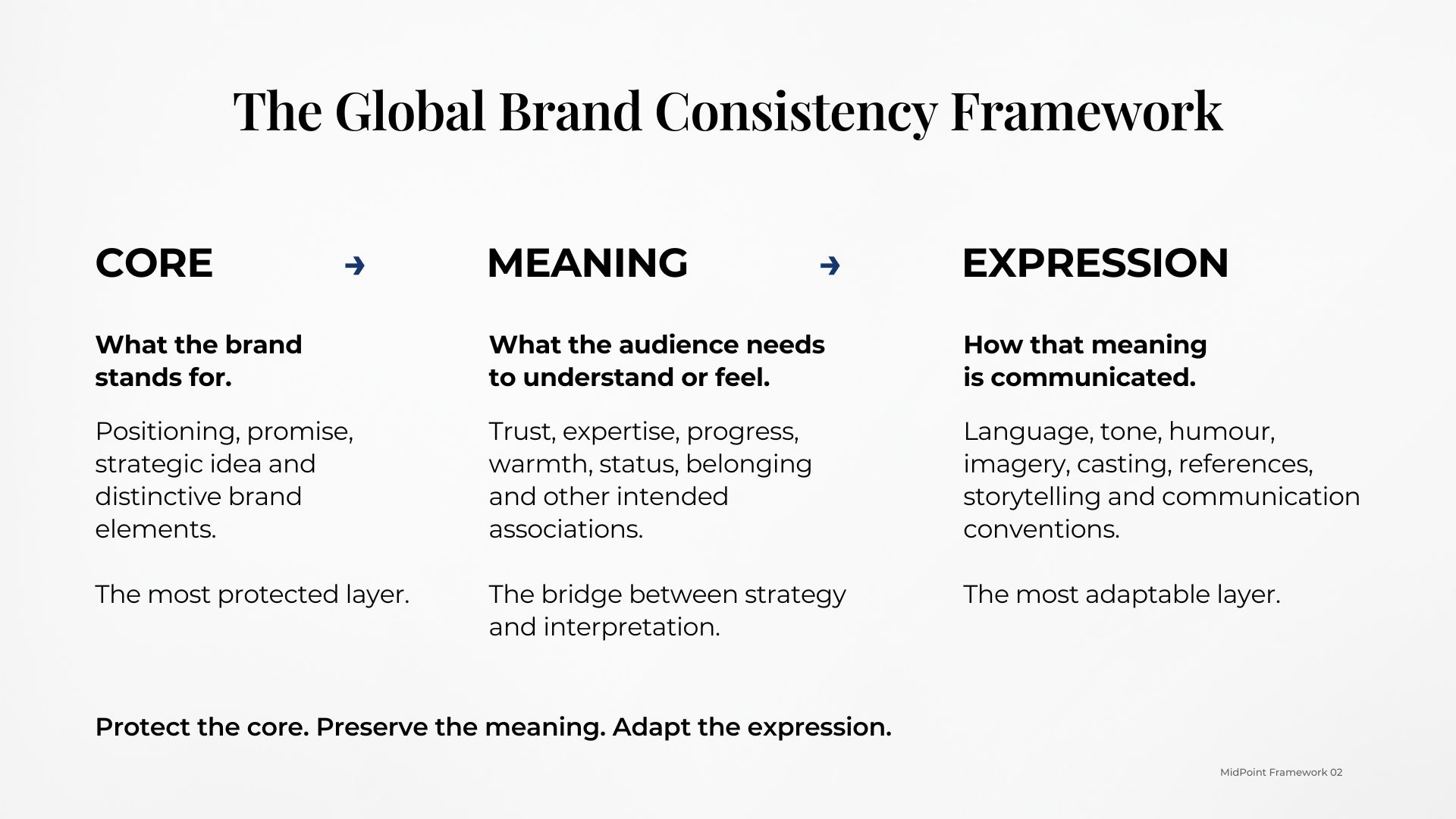
Instead of beginning with a master execution and asking markets to reproduce it, begin by establishing a hierarchy of what cannot change.
Protect the positioning and strategic proposition first. Define the meaning the audience must take away and identify the distinctive brand elements that require global continuity. Only then examine the expression: language, tone, humour, imagery, references, casting, examples and communication conventions.
Some will require adaptation. Others will not. The objective is not maximum localisation. It is minimum necessary adaptation without losing the brand.
This also creates a much better brief for AI. “Translate this campaign into Spanish” gives the system language to reproduce. A brief explaining that the brand should feel intelligent, confident and accessible, while protecting a specific proposition and distinctive assets, gives it strategic intent to preserve.
Local teams can work in the same way. Instead of judging their output by how closely it resembles headquarters’ original, evaluate whether it preserves the intended meaning while remaining credible in its context.
Translation then stops being an exercise in reproduction and becomes an exercise in interpretation.
The MidPoint Takeaway
A global brand does not need to look or sound identical everywhere to remain consistent. It needs to remain strategically recognisable.
Decades of research suggest that neither standardisation nor adaptation provides a universal answer. The more useful capability is knowing which layer of the brand you are dealing with.
Protect the core. Understand the meaning. Adapt the expression when the context requires it.
AI will make producing twenty versions of a campaign increasingly easy. The difficult part will be knowing why version twenty should be different from version one.
Perhaps that is what global brand consistency has always required: not the discipline to repeat yourself everywhere, but the judgement to know what must stay the same when everything around it changes.
Ewa Gillen
Brand & Creative Lead
Healthcare, Technology and Science | B2B & Purpose-Driven Brands
MidPoint explores the intersection of brand strategy, creativity and AI transformation.
References
- Theodosiou, M., & Leonidou, L. C. (2003). Standardization versus adaptation of international marketing strategy: An integrative assessment of the empirical research. International Business Review, 12(2), 141–171.
- Brei, V. A., D’Avila, L., Camargo, L. F., & Engels, J. (2011). The influence of adaptation and standardization of the marketing mix on performance: A meta-analysis. Brazilian Administration Review, 8(3), 266–287.
- Mandler, T., Sezen, B., Chen, J., & Özsomer, A. (2021). Performance consequences of marketing standardization/adaptation: A systematic literature review and future research agenda. Journal of Business Research, 125, 416–435.
- Hornikx, J., Janssen, A., & O’Keefe, D. J. (2026). Cultural value adaptation in advertising is effective, but not dependable: A meta-analysis of 25 years of experimental research. International Journal of Business Communication, 63(2), 217–247.
AI Transparency
Generative AI and AI-assisted research tools, including ChatGPT, Claude and Perplexity, supported the research and editorial process. Final editorial responsibility remains with the author.


Comments are closed.