



Generative models are trained on what a culture has already written down. Everything it hasn’t is where the work begins.
In December 2025, a group of clinicians, pharmacists and researchers set out to test how well the leading language models handle women’s health. They wrote realistic questions of the kind patients and doctors actually ask, and put each one to a state-of-the-art model. More than a quarter of the answers came back wrong. Incorrect dosages. Outdated guidance. Missed urgency. 1
You may be wondering why a brand strategist is opening with a medical benchmark. Because what it measures is not really the intelligence of the models. It is the shape of what we, as a society, have bothered to write down, and no next release will fix that.
The gaps are not random. They cluster with unnerving precision around subjects our culture has been reluctant to discuss out loud. Once you accept that, a question that looks technical turns strategic: if AI is weakest where we have said least, then the map of AI’s blind spots is also a map of unmet need.
Models inherit our silences before they inherit our knowledge
A language model learns from what has already been recorded, published and made available to it. It becomes confident where knowledge is abundant and uncertain where it is scarce. But what gets recorded has never been neutral. It reflects decades of decisions about what deserved funding, what was researched, what got published and what people were willing to talk about.
Follow one subject backwards and it becomes uncomfortably clear. Only 8.8% of NIH grant spending between 2013 and 2023 went to women’s health research, even as the agency’s overall budget increased.2 Across 740 cardiovascular trials, women made up 38.2% of participants in the disease category that kills more women than any other.3 Even when both sexes were included, fewer than 9% of mixed-sex trials analysed their findings by sex. 4
Underfunded, then under-enrolled, then under-analysed, then under-published. Four filters, each narrower than the last, every one of them applied long before a word of it reached a training set.
We often think of AI as a mirror reflecting human knowledge. It behaves more like a lens, amplifying what is already well documented while leaving everything else in the shadows. Whatever a culture has avoided discussing, these systems will underserve, fluently, confidently, at scale.
Silence is not the absence of a market. It is the absence of supply.
Researchers at Data & Society named this long before it mattered to anyone in branding. A data void is a question people are genuinely asking that almost nobody has answered well. Their concern was manipulation: voids get filled, and whoever fills one first owns the answer. Read it the other way and you are looking at something else entirely. Demand that gathered long ago, waiting for a supply that never arrived. 5
Consider one example. A systematic review of studies across the Western world found that roughly one in three women experience urinary incontinence in the year after giving birth. 6 Yet women with the condition live with symptoms for more than six years before raising it with a doctor, and roughly four more before receiving effective treatment. 7 The reasons given are often shame, lack of time, and a version of the same sentence: I was told this was normal.
Those ten years are the point. A data void is not empty of people, only of answers. The demand is there the whole time, but it never reaches anyone who might write it down, so nothing gets published and nothing exists for a search engine, or a model, to find. Conventional tools, including keyword research, only capture the questions people have learned they are allowed to ask. They are far less effective at revealing the questions people are still too embarrassed, uncertain or unsupported to express.
Not every silence is a market. Some are ethical problems with no business attached; some subjects are undocumented simply because nobody needs them answered. But where a silence and a real audience meet, something unusual happens, and the rest of this article is about what.
No Taboo Mom:
Building a brand around what women were not saying
I know what that silence looks like from the inside, because we built a brand inside one.
The silence around womanhood and motherhood is not a local failure of one country or one health system. It repeats across borders and generations. Women learn early which parts of the experience are welcome in conversation and which are not. Birth is discussed; birth injury is not. Exhaustion is discussed; ambivalence, rage, sexual pain, incontinence and the loss of a former self are not. What cannot be said is not written down, and what is not written down does not exist for anyone searching for it later.
That is the void No Taboo Mom was built in. Not a market we identified, but a gap my co-founder Julia Kolbe, a psychiatric nurse and medical educator, and I kept walking into ourselves.
The strategic problem was unusual. Normally a client arrives with material and the job is to organise, sharpen and amplify it. Here there was almost nothing to organise, and the reason was not neglect. People rarely state a need in the language an organisation expects. They speak indirectly, or minimise what happened, or ask whether something is normal because they do not yet know that another answer is possible. Before a brand can answer a need like that, it has to build the conditions in which the need can be said out loud.
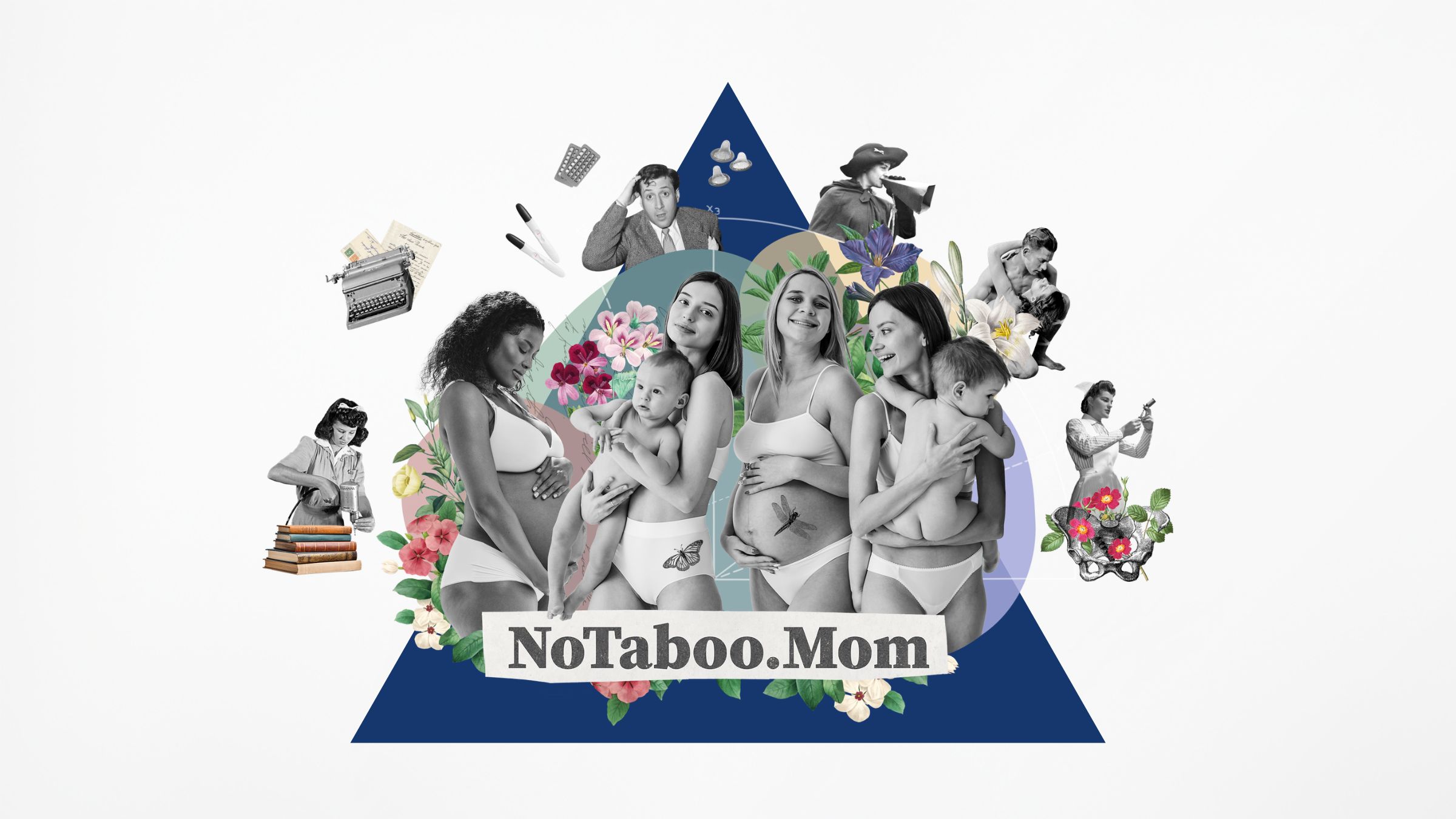
Everything else followed from that. The editorial voice had to be direct without being sensationalist, informed without becoming clinical, personal without turning one woman’s story into a rule. The visual system had to make hard subjects approachable while refusing the idealised imagery motherhood usually attracts. Collage became the organising language: fragmented photography, natural forms and bold typography, holding vulnerability, strength, discomfort and humour in a single frame, at just enough distance to approach difficult material without sterilising it or turning it into trauma imagery. Six categories each carry their own colour, so a woman can navigate to her own subject without having to name it first.
The design does not illustrate the stories. It gives the reader permission to enter them.
The proof that it worked was not traffic. Women began writing to us with things they had told nobody, and where we can we connect them to people who can genuinely help, among them MASIC, the UK charity supporting women with severe birth injuries, and Dr med. Martina Lenzen-Schulte, who documents birth risks for German-speaking readers. You only become a referral point if people arrive expecting an answer and find one.
Recognition came later and was never the goal: a nomination in the Impact category of Project of the Year 2023/2024 by STGU, the Association of Applied Graphic Designers in Poland, and Best Website Design from DesignRush in 2025.
Which brings the argument back. AI could approximate the collage in an afternoon. It could write articles about motherhood and imitate a compassionate tone. What it cannot reproduce is why women chose to trust this particular platform, the judgement required to handle what they send us, or the years of listening that shaped what it became.
The defensible asset was never the archive. It is the relationship that made the archive possible.
No Taboo Mom website: notaboo.mom and Instagram
What this changes for creative teams
For most of my career, creative work depended on execution: the studio, the retoucher, the production budget. Today, execution is easier than ever. The real advantage comes from understanding people in ways your competitors don’t, and that has quietly shifted the focus of creative teams from production to research.
Use the models as a diagnostic, not an authority. Take the real questions your sales and service teams hear, the hesitant ones, the half-questions, the ones prefaced with this is probably nothing, and put them to the best model you have. Where it hedges, generalises or is confidently wrong, documentation is thin and every competitor’s model is producing the same hollow answer.
Then remember what you have actually found. Not a brand position, but a question worth investigating. AI can show you the edge of the documented world; it cannot tell you what lies beyond it, or whether anyone out there is waiting. That takes people: the affected, the experts, the ones who know why the subject was neglected. It also takes a reason to stay long enough to be trusted, and no strategy deck can manufacture one.
Do not fill the gap with generated content. The efficient move is to publish hundreds of articles and claim the territory. The strategic move is to protect what makes the position valuable. Trust is built through named people, visible provenance and the willingness to send someone elsewhere when the answer isn’t yours to give.
In budget terms, money moves from production to knowledge acquisition. Interviews, field research, practitioner time and expert review stop being overheads on the way to a deliverable. They become the work itself. That shift is now one of the clearest signals of whether an organisation has understood what changed.
The MidPoint Takeaway
These systems are fluent about everything we have already said, and far less capable where knowledge is limited, fragmented or still emerging.
For decades, brand strategy often meant finding a distinctive angle on a well-covered subject. Generative AI has made that work dramatically easier—and therefore far less distinctive. AI is exceptionally capable on well-documented ground. That is also where every organisation now has access to increasingly similar knowledge, patterns and creative capabilities.
The strategic shift is not towards finding more content to generate. It is towards developing an understanding others don’t yet have. That understanding comes from research, observation, expertise and direct contact with the people a brand exists to serve. AI can help identify the edge of what is already known. It cannot tell you what exists beyond it, or whether it matters. That still requires curiosity, research and the trust of the people whose experiences have never fully entered the record.
The strongest brand positions are no longer built by saying something different about the same thing. They are built by understanding something different before anyone else does.
Ewa Gillen
Brand & Creative Lead
Healthcare, Technology and Science | B2B & Purpose-Driven Brands
MidPoint explores the intersection of brand strategy, creativity and AI transformation.
References
- A Women’s Health Benchmark for Large Language Models.
- A New Vision for Women’s Health Research: Transformative Change at the National Institutes of Health.
- Women’s Participation in Cardiovascular Clinical Trials From 2010 to 2017.
- Mind the Gap: Reporting and Analysis of Sex and Gender in Health Research in Australia, a Cross-Sectional Study.
- Data Voids: Where Missing Data Can Easily Be Exploited
- Prevalence, incidence and bothersomeness of urinary incontinence between 6 weeks and 1 year post-partum: a systematic review and meta-analysis
- Novel EMPOWER Study of Female Urinary Incontinence Reaches Halfway Point
- Harvard Business School Online. AI Essentials for Business. Professors Karim R. Lakhani and Marco Iansiti, 2026.
AI Transparency
Generative AI supported the research and editorial process for this article, and generative AI was used to produce the campaign imagery described in the Polish Institute Berlin project. All strategic direction, creative judgement and final editorial responsibility remain with the author.


Comments are closed.